Astro MK-1 Technical Abilities, Autonomy, Mission Profile, Roles, Manufacturing Costs, and Economic Impact Technical Abilities.
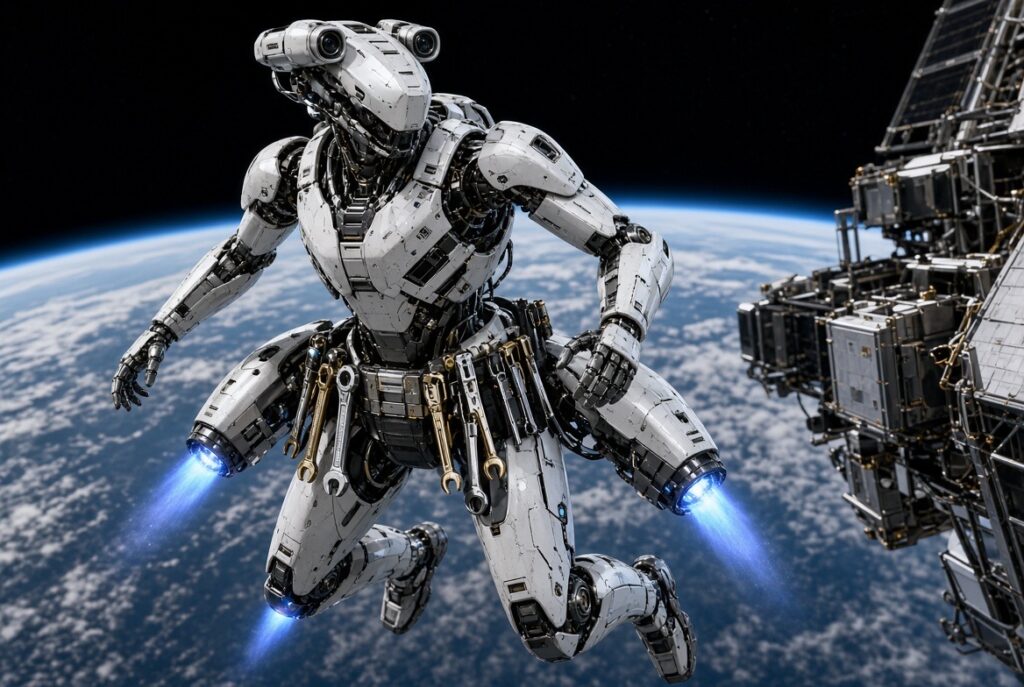
Astro MK-1 is a free-flying full-torso humanoid platform designed for on-orbit operations.
Core capabilities include:
- 6-DOF free-flight mobility via distributed cold-gas or equivalent thrusters on the limbs and torso for precise translation and attitude control.
- Full rigid torso for structural stiffness, favorable inertia distribution, reaction management during arm motion, and mounting of power, compute, tools, and thrusters.
- Dexterous hands capable of tool use, connector mating, panel manipulation, and fine force-controlled contact.
- Modular tool belt with quick-swap end effectors and standard EVA-style tools (wrenches, drivers, probes, etc.).
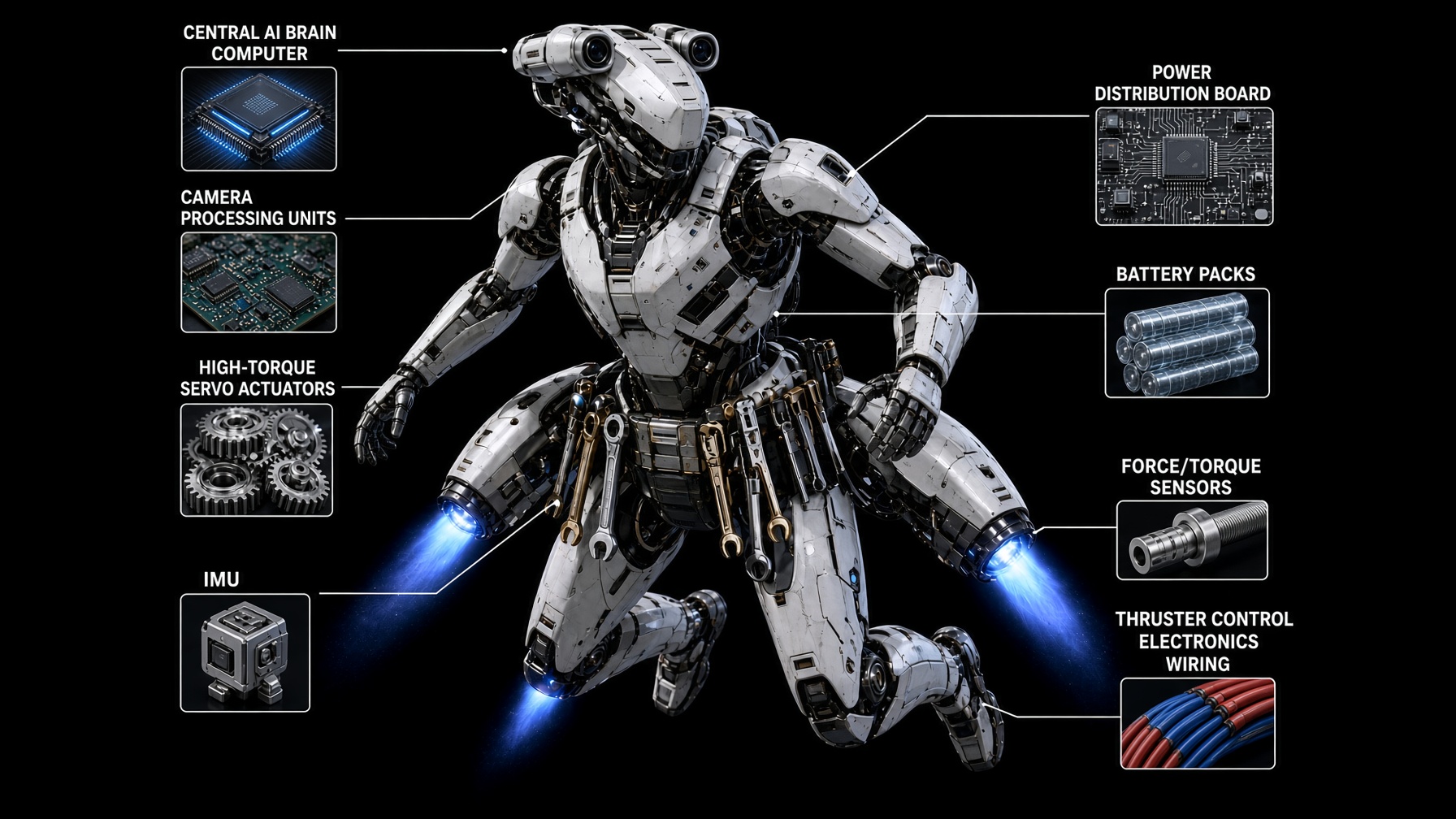
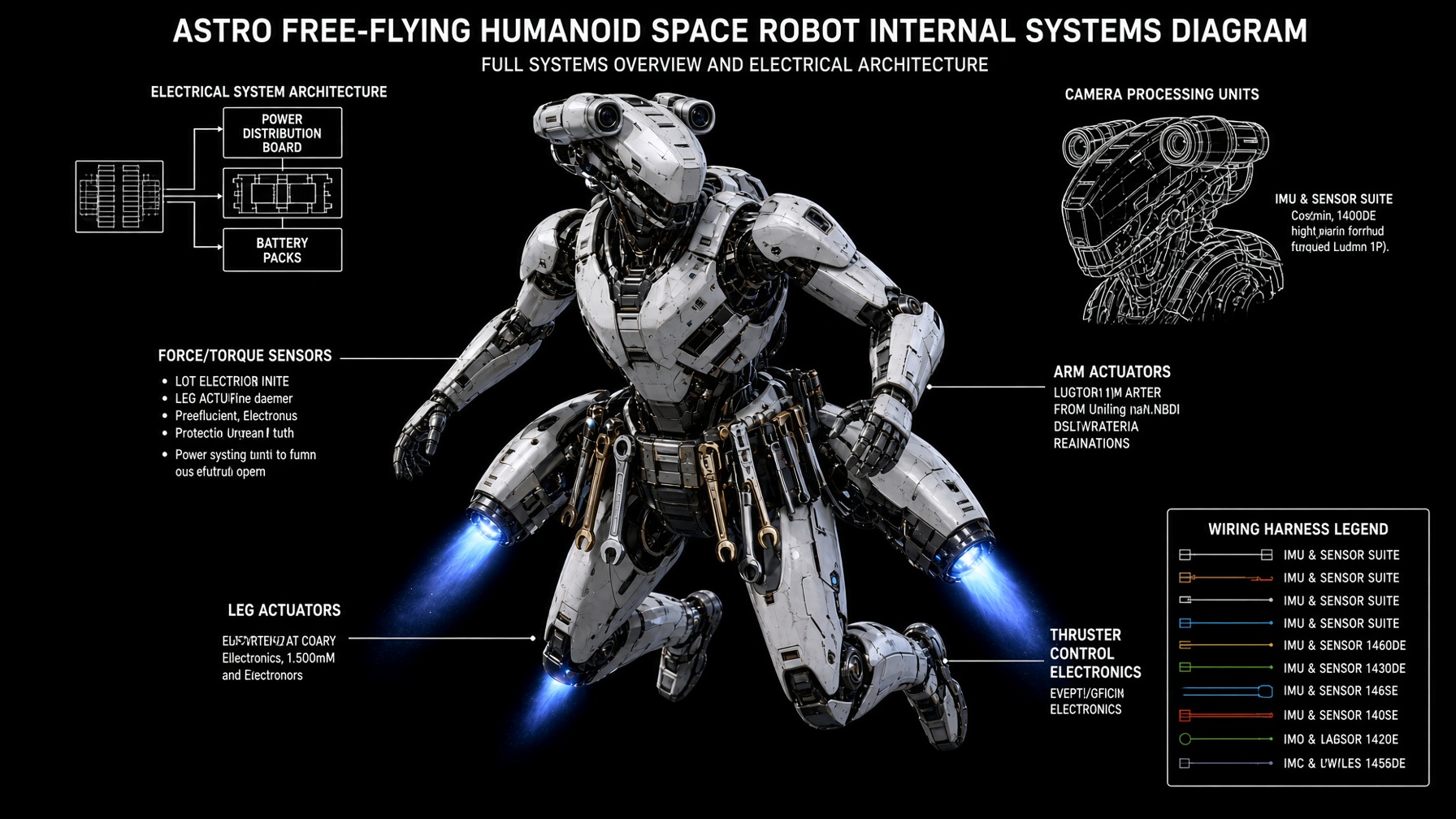
- Sensor suite including stereo/depth cameras, IMU, force/torque sensing at the wrists, and status monitoring for autonomous alignment and contact tasks.
- Force-aware control so the robot can apply controlled loads without damaging itself or the target satellite.
Autonomy with AI After a high-level mission is uploaded, Astro operates with a high degree of autonomy:
- Onboard AI (edge compute such as NVIDIA Jetson-class or equivalent) handles perception, path planning, force-limited manipulation, and anomaly detection.
- Supports supervised autonomy, scripted sequences, and fully autonomous execution for routine servicing tasks.
- Can switch to teleoperation or ground-in-the-loop mode when needed.
- Learns and refines behaviors from prior missions; force and vision feedback allow it to adapt to minor differences in satellite interfaces without constant reprogramming.
- Safety layers enforce torque/force limits, collision avoidance, and automatic abort if contact forces exceed thresholds.
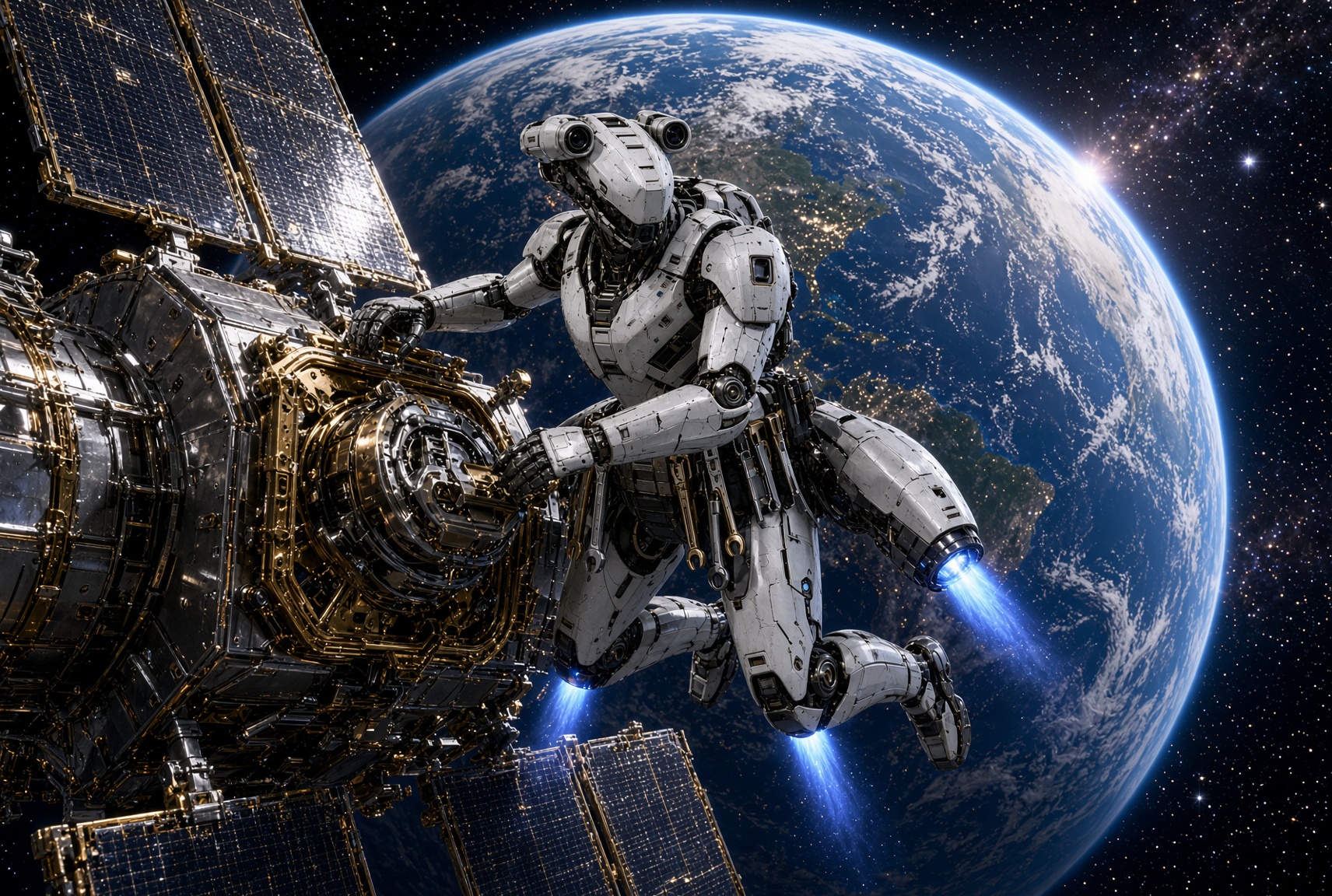
Mission Specifics – Typical missions include:
- Inspection and anomaly assessment
- Component replacement or upgrade
- Connector mating and electrical/fluid interface work
- Solar panel or antenna adjustment
- Debris mitigation support or safe grappling
- Station-keeping and close-proximity operations around both cooperative and prepared non-cooperative targets
Astro is designed to work on commercial constellations, SpaceX-class platforms (once interfaces are compatible or adapted), and military/national-security assets.
Roles Astro Can Play: The same core vehicle supports multiple roles through modular tools and software loads:
- Primary servicing technician — repair, refuel interface support, and life-extension tasks.
- Astronaut assistant — handles routine or high-risk external work on crewed vehicles.
- Inspection / pilot — free-flying reconnaissance and detailed visual or sensor surveys.
- Soldier / Security / support — asset protection, anomaly investigation, or rapid-response configuration in contested environments.
- Multi-role platform — can be reconfigured for different end-effectors or mission software without a full vehicle redesign.
Economic Savings Potential
Commercial Companies
Large GEO communications satellites commonly cost $150–500 million to replace (build + launch + insurance). On-orbit life-extension or repair missions are typically estimated in the $20–100 million range in industry analyses and can add 3–7+ years of revenue-generating life. A single successful Astro servicing mission on a high-value commercial satellite can therefore avoid or defer $100–300+ million in replacement costs while preserving ongoing revenue (often tens of millions per year). Across a constellation or operator fleet, cumulative savings scale rapidly.
SpaceX / LEO constellation operators Individual Starlink-class satellites are far cheaper (roughly $250,000–800,000 to manufacture plus launch share, with total delivered cost often cited in the low millions or less per unit at volume). However, constellations require continuous replacement.
Astro’s value here is selective repair or upgrade of higher-value or strategically placed units, anomaly recovery, and reduction in the rate of full replacements. Even modest success rates on a large constellation can save tens to hundreds of millions over time by lowering the annual replenishment burden.
Military / National-Security Platforms
High-value military and classified satellites frequently range from tens of millions to well over $100–300+ million per spacecraft (and often far higher for specialized systems). Inability to service them forces full replacement cycles.
Astro enables life extension, on-orbit reconfiguration, inspection, or rapid anomaly response without launching a new vehicle. Avoiding even one or two full replacements of sensitive assets can represent savings of $100–500+ million per event, plus strategic value from preserved capability and reduced vulnerability.
Manufacturing Cost (Indicative)
- Prototype / terrestrial free-flight testbed: roughly $50,000–150,000 depending on actuator grade, hands, thrusters, and compute (building on existing dual-arm platforms such as OpenArm plus custom torso and thruster integration).
- Early operational units (space-capable but not fully flight-qualified): estimated in the low-to-mid hundreds of thousands of dollars per unit at small production volumes.
- Mature production units: target significantly lower per-unit cost through standardization, volume, and modular design. Exact figures will depend on qualification level, thruster type, and radiation hardening.
These are order-of-magnitude estimates for planning; full space qualification and flight hardware will increase cost.
Summary impact
Industry analyses of the on-orbit servicing market project multi-billion-dollar annual opportunity by the early 2030s, driven primarily by life-extension economics. Astro’s free-flying, tool-equipped, AI-autonomous design is positioned to capture a portion of that value across commercial, SpaceX-class, and military customers by converting irreplaceable space assets into maintainable infrastructure.These figures are based on publicly reported satellite costs, industry market studies, and typical life-extension economics as of 2026. Actual savings will depend on mission success rate, interface compatibility, and operational cadence.